Castle Park’s vibrant community spirit and diverse property landscape create a neighborhood where homeowners and business owners alike recognize the value of quality infrastructure. Located in the heart of Chula Vista, this established area combines residential streets with thriving commercial corridors, creating varied pavement needs that demand professional expertise. Your driveway, parking lot, or access road represents more than a simple surface—it’s a critical investment affecting property functionality, safety, curb appeal, and long-term maintenance costs that ripple through ownership for decades.
The difference between professional asphalt work and amateur attempts becomes painfully obvious within months rather than years. Properly installed pavement serves reliably for 20-30 years with basic maintenance, while shortcuts in base preparation, material quality, or installation technique lead to premature failure requiring expensive replacement within 5-10 years. Understanding what separates quality asphalt contractors from budget operators helps Castle Park property owners make informed decisions that protect investments, enhance properties, and avoid the costly do-overs that plague those who prioritize initial price over long-term value.
Castle Park’s Distinctive Asphalt Challenges
Southern California’s intense sunlight delivers year-round UV radiation that accelerates asphalt oxidation far faster than northern climates experience. This constant exposure breaks down the petroleum binders holding aggregate together, causing surfaces to become brittle, fade to gray, and develop the cracking that allows water infiltration and progressive deterioration. Castle Park properties require asphalt formulations and protective maintenance specifically designed for this relentless solar exposure that defines San Diego County’s climate advantages and infrastructure challenges simultaneously.
Temperature extremes between summer daytime highs and winter nighttime lows create expansion-contraction cycles stressing pavement throughout the year. While San Diego avoids the freeze-thaw damage devastating northern pavements, the daily and seasonal temperature variations still generate stress that poorly designed installations cannot withstand. Professional contractors understand these thermal movements, incorporating proper joint placement, adequate thickness specifications, and appropriate mix designs that accommodate Castle Park’s temperature patterns without developing structural cracks.
Soil conditions throughout Chula Vista vary considerably, affecting base requirements and long-term pavement performance. Some Castle Park areas feature expansive clay soils that swell when wet and shrink during dry periods, creating ground movement that cracks inadequately supported pavement. Other locations contain sandy or decomposed granite soils requiring different base approaches for proper support. Local contractors familiar with these geological variations adjust specifications ensuring installations perform well despite challenging subsurface conditions that generic approaches fail to address.
Traffic patterns in Castle Park range from quiet residential streets to busy commercial corridors along major thoroughfares. Business parking lots experience constant vehicle turnover with cars repeatedly starting, stopping, and turning in confined spaces—wear patterns completely different from residential driveways used twice daily. These usage differences demand varied pavement specifications, with commercial applications requiring thicker asphalt sections, more robust base preparation, and potentially modified asphalt mixes resisting the accelerated wear that light-duty residential specifications cannot withstand long-term.
The Foundation of Lasting Asphalt Performance
Base preparation determines pavement longevity more conclusively than any other single factor in asphalt installation. The base provides stable support distributing vehicle loads to underlying soil, creates drainage pathways preventing water accumulation beneath pavement, and establishes the platform determining whether surfaces remain smooth or develop depressions and failures. Professional contractors invest tremendous effort in base work that customers never see but absolutely determines whether installations last decades or fail within years despite identical surface asphalt.
Aggregate base material quality affects load distribution and long-term stability profoundly. Crushed rock base compacts to higher density than rounded gravel, creating superior interlock and stability. Gradation—the distribution of particle sizes from fine to coarse—affects compaction quality and drainage characteristics significantly. Professional contractors specify appropriate base materials for project-specific conditions rather than using whatever’s cheapest or most readily available regardless of suitability for actual site conditions and intended pavement use.
Compaction transforms loose aggregate into stable platforms supporting pavement loads without settlement. Proper compaction requires placing base material in controlled lifts—typically 6 inches maximum—compacting each lift to 95% of maximum density before adding subsequent layers. Testing verifies compaction rather than assuming adequate results from visual inspection alone. Professional contractors own or rent vibratory plate compactors and rollers appropriate for project scale, achieving specified compaction that prevents the settlement causing surface cracking and pothole formation plaguing inadequately compacted installations.
Drainage design prevents the water damage destroying more pavement than all other causes combined. Proper grading creates positive slopes—minimum 2% grade—directing water away from structures toward streets, drainage systems, or designated collection areas. Some installations benefit from subsurface drainage layers beneath base material, perforated pipes collecting and removing groundwater, or surface drainage structures handling concentrated flows. Professional contractors evaluate drainage comprehensively during planning, implementing solutions preventing water accumulation that saturates bases and causes progressive pavement failure.
Professional Installation Creating Decades of Performance
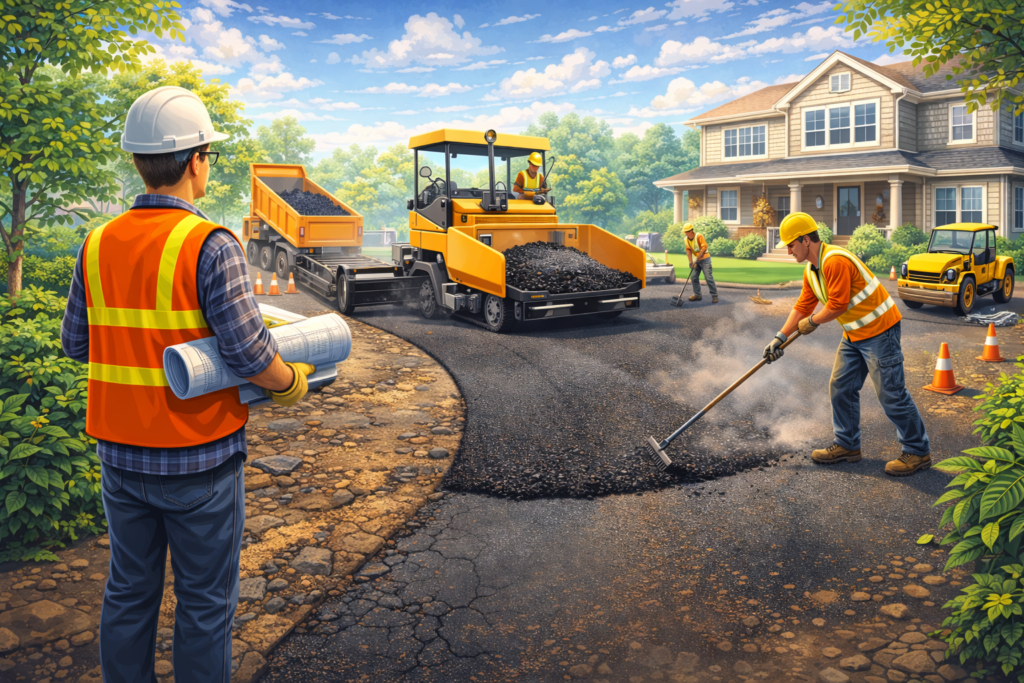
Hot mix asphalt installation demands precise timing coordinating material production, transportation, placement, and compaction within narrow temperature windows. Asphalt leaves plants at approximately 300°F and must reach minimum compaction temperatures before cooling prevents proper densification. Professional paving crews work efficiently, spreading material immediately upon delivery and compacting systematically before cooling compromises results. This time-sensitive process requires experienced crews, appropriate equipment, and logistical coordination that amateur operations consistently fail to execute properly.
Asphalt thickness specifications vary by application, with residential driveways typically requiring 2-3 inches of compacted asphalt over proper base while commercial parking lots may need 3-4 inches or more depending on anticipated traffic loads. Attempting to save money through inadequate thickness guarantees premature failure regardless of installation quality otherwise. Professional contractors recommend appropriate thickness for specific applications rather than universally applying residential specifications to commercial projects or vice versa without considering actual load requirements and performance expectations.
Joint placement and construction prevent cracking at predictable stress concentration points. Control joints—planned cracks in predetermined locations—prevent random cracking throughout pavement by providing stress relief at regular intervals. Construction joints where paving stops and resumes require proper preparation ensuring strong bonds between successive placements. Edge joints against existing pavement, structures, or concrete need appropriate tack coat application and compaction attention creating durable transitions. Professional attention to joint details prevents the edge failures and joint deterioration that develop when these critical areas receive inadequate attention.
Surface finishing creates the final appearance and texture affecting both aesthetics and functionality. Proper rolling compaction achieves target density while creating smooth surfaces free from roller marks, segregation, or other defects. Final passes with rollers establish surface texture providing appropriate traction without excessive roughness affecting ride quality or appearance. Professional crews understand finishing techniques appropriate for different mix types and applications, delivering surfaces that look professional while performing properly rather than exhibiting the obvious defects that mark amateur installations.
Why Castle Park Properties Need Local Expertise
Castle Park’s unique position within Chula Vista creates specific considerations for asphalt work that experienced local contractors understand instinctively. Proximity to commercial corridors, residential density variations, and neighborhood development patterns all influence project planning, material sourcing, and execution strategies. An established Asphalt contractor Castle Park brings knowledge developed through years serving this specific community, understanding which streets present access challenges, where soil conditions create special requirements, and how local weather patterns affect optimal work timing.
Relationships with local material suppliers provide advantages that distant contractors cannot match. Established contractors know which San Diego County asphalt plants produce quality mixes meeting specifications consistently, which aggregate suppliers provide proper base materials, and which concrete suppliers deliver on schedule without the delays plaguing less-established operations. These relationships facilitate competitive pricing through volume purchasing, ensure material availability maintaining project schedules, and provide accountability when quality issues arise requiring supplier response and resolution.
Chula Vista’s permit requirements and inspection procedures demand familiarity that experienced local contractors possess inherently. The city’s building department establishes specific requirements for different project types and locations. Right-of-way work requires additional permits and coordination. Environmental regulations govern runoff management and disposal. Local contractors navigate these requirements efficiently through regular interaction, submitting complete applications, responding to agency questions knowledgeably, and coordinating inspections at appropriate project stages without the delays and complications that plague unfamiliar operators.
Community reputation creates powerful accountability incentives for local contractors whose previous work remains visible throughout neighborhoods where they operate. Quality installations serve as ongoing advertisements while substandard work provides cautionary examples affecting future business opportunities. This visibility incentivizes consistent workmanship and customer service that national chains or transient operators don’t face—directly benefiting Castle Park property owners through contractors’ commitment to maintaining excellent community standing that supports long-term business success.
Investment Analysis and Property Value Enhancement
Residential asphalt installation costs in Castle Park typically range $4-8 per square foot for complete professional work including proper base preparation, quality materials, and skilled installation. A standard two-car driveway averaging 600 square feet costs approximately $2,400-4,800 installed. Commercial parking lot costs range $3-6 per square foot depending on size, specifications, and site conditions, with larger projects benefiting from economies of scale that reduce per-square-foot costs while smaller projects face proportionally higher mobilization and setup expenses.
Cost variations reflect genuine project differences rather than arbitrary pricing. Challenging access requiring smaller equipment and more labor increases costs. Difficult soil conditions demanding deeper excavation and additional base material raise expenses. Complex drainage requiring subsurface systems adds to budgets. Decorative borders, unusual shapes, or premium surface treatments increase prices beyond basic installations. Understanding these cost drivers helps property owners evaluate proposals meaningfully rather than assuming all quotes for similar square footage should match regardless of site-specific conditions.
Maintenance costs over pavement lifespan significantly impact total ownership expenses beyond initial installation. Sealcoating every 2-3 years at approximately $0.20-0.35 per square foot protects against oxidation and extends life substantially. Crack sealing prevents minor issues from becoming expensive problems. Periodic cleaning removes debris and prevents staining. When performed consistently, these maintenance investments extend asphalt life to 25-30 years while neglected pavement often fails within 12-15 years despite identical initial installation quality.
Property value enhancement justifies asphalt investment for many Castle Park owners beyond pure functionality considerations. Quality driveways dramatically improve curb appeal, creating positive first impressions that affect buyer interest and offer amounts. For commercial properties, well-maintained parking areas influence customer perceptions and competitive positioning in markets where appearance signals overall business quality. Real estate professionals consistently identify pavement condition among the most noticed exterior features affecting both residential and commercial property values and marketability.
Maintenance Strategies Maximizing Pavement Investment
Sealcoating represents the single most effective asphalt maintenance practice available to property owners. This protective treatment applies coal tar or asphalt emulsion sealers creating barriers against UV oxidation, water infiltration, and chemical damage from automotive fluids. Applied every 2-3 years beginning 6-12 months after installation, sealcoating preserves asphalt flexibility, prevents premature aging, and restores rich black appearance that enhances property aesthetics significantly. Most property owners can apply sealcoating themselves using products from hardware stores, though professional application ensures uniform coverage and optimal results.
Crack sealing prevents minor surface issues from becoming structural failures requiring expensive repairs. Small cracks allow water infiltration saturating base materials, causing progressive deterioration that eventually requires complete reconstruction. Flexible crack filler products seal these openings, preventing water penetration while accommodating the thermal expansion and contraction that caused initial cracking. Annual inspections identify new cracks requiring attention before they widen or multiply into damage beyond simple sealing, maintaining pavement integrity through proactive intervention rather than reactive crisis management.
Proper cleaning removes debris, organic material, and automotive fluids that degrade asphalt over time. Regular sweeping prevents dirt accumulation that retains moisture against surfaces. Pressure washing removes stubborn staining and biological growth without the harsh chemicals that can damage asphalt. Cleaning oil and fuel spills immediately prevents petroleum product penetration that softens asphalt binder, creating depressions where aggregate loosens under traffic. These straightforward practices preserve both pavement integrity and appearance while demonstrating property care that neighbors and customers notice and appreciate.
Drainage maintenance ensures water flows away from pavement rather than infiltrating or ponding on surfaces. Keep edges clear of soil buildup blocking drainage. Maintain vegetation preventing grass encroachment onto pavement edges. Address settling creating low spots where water accumulates—these depressions accelerate deterioration through constant moisture exposure that breaks down asphalt even through intact sealcoating. Simple drainage attention prevents the water-related damage causing most premature pavement failures regardless of installation quality or maintenance history otherwise.
Environmental Responsibility in Modern Asphalt Work
Asphalt recycling makes this material among the most recycled in America, with reclaimed asphalt pavement (RAP) incorporated into new mixes at rates often exceeding 30% by weight. Removed asphalt from Castle Park driveways and parking lots gets crushed, screened to size specifications, and blended into new hot mix asphalt without performance compromises. This recycling conserves virgin aggregate, reduces energy consumption compared to all-new production, and diverts substantial material volumes from California’s landfills. Professional contractors prioritize recycling as both environmental responsibility and economic efficiency benefiting project budgets.
Permeable asphalt options address stormwater management requirements through surfaces allowing water infiltration into underlying stone reservoirs. While traditional asphalt remains impermeable, permeable alternatives provide environmental benefits for appropriate applications where stormwater reduction provides value. Water filters through pavement into storage layers, reducing runoff volumes while removing pollutants before eventual percolation or discharge. Though not suitable for all applications—particularly high-traffic areas or locations with contamination concerns—permeable asphalt offers sustainable solutions for environmentally conscious property owners.
Cool pavement technologies using light-colored aggregates or reflective coatings reduce heat absorption compared to traditional dark asphalt surfaces. These treatments remain cooler during sunny days, reducing heat island effects while potentially lowering cooling costs for adjacent buildings. Southern California’s climate makes heat island reduction particularly valuable, with cool pavements contributing to more comfortable outdoor spaces and reduced energy consumption. While adding modest cost premiums, these technologies align with California’s environmental leadership while providing practical comfort and efficiency benefits.
Responsible construction practices minimize environmental impacts during installation beyond simple material selection. Dust control through water application protects air quality in surrounding neighborhoods. Equipment maintenance prevents fuel and hydraulic fluid leaks contaminating soil. Runoff management during construction prevents sediment discharge to storm systems. Professional contractors implement these practices as standard operating procedures rather than only responding after complaints or violations, demonstrating genuine environmental stewardship valued throughout California’s environmentally conscious communities.
Selecting the Right Asphalt Professional
California contractor licensing verification provides essential protection when evaluating asphalt contractors. The Contractors State License Board requires appropriate licensing for paving work, with C-12 (Earthwork and Paving) classification indicating proper credentials. Verify active license status through CSLB’s online verification system, checking for disciplinary actions, unresolved complaints, or other red flags indicating contractors to avoid. This straightforward verification eliminates numerous unqualified operators before investing time in detailed proposal evaluation or making financial commitments.
Comprehensive insurance coverage protects property owners from liability inherent in construction operations. General liability insurance should provide adequate limits covering property damage and bodily injury from paving activities—minimum $1 million per occurrence with $2 million aggregate is standard. Workers compensation insurance protects against liability for worker injuries occurring on your property. Request insurance certificates documenting coverage, verify limits adequately protect your interests, and confirm coverage directly with insurance carriers rather than relying solely on contractor-provided documentation that occasionally proves fraudulent.
Local references from recent Castle Park or Chula Vista projects provide the most reliable contractor evaluation available. Request contacts for comparable projects completed within the past year, then actually call those references asking specific questions about their experiences. Were timelines met? Did costs match estimates or inflate through change orders? How was communication? Would they hire this contractor again without hesitation? Drive by referenced properties observing work quality firsthand when possible. Multiple enthusiastic references from nearby comparable projects indicate consistent quality and relevant local experience.
Detailed written proposals protect both parties through comprehensive documentation of expectations, specifications, and deliverables. Complete proposals specify excavation depth, base material type and thickness, asphalt specifications and thickness, edge treatments, drainage provisions, cleanup scope, timeline with milestones, payment schedule, and warranty terms. Vague estimates hide assumptions creating dispute opportunities when expectations don’t match deliveries—comprehensive specifications establish shared understanding preventing the misunderstandings that create dissatisfaction despite technically competent work execution.
Your Castle Park property deserves asphalt work combining technical expertise, quality materials, proper equipment, and professional execution that delivers decades of reliable performance while enhancing property value and functionality throughout ownership.
Frequently Asked Questions
How long before I can drive on new asphalt? Light vehicle traffic is typically safe after 24-48 hours, though full curing takes 6-12 months. During initial curing avoid heavy loads, sharp turns in the same spots repeatedly, and parking in identical locations constantly. These restrictions prevent surface marking and deformation while asphalt achieves full hardness and strength.
What causes asphalt to crack prematurely? Common causes include inadequate base preparation, insufficient asphalt thickness, poor drainage allowing water infiltration, lack of maintenance like sealcoating, and extreme temperature cycles. Sometimes unavoidable factors like soil movement or tree root intrusion contribute despite quality installation. Professional assessment determines specific causes informing appropriate repair approaches.
Is sealcoating really necessary in San Diego’s climate? Yes—Southern California’s intense UV exposure accelerates oxidation making sealcoating particularly beneficial. While you won’t face freeze-thaw damage like northern climates, solar radiation breaks down asphalt binder relentlessly. Regular sealcoating blocks UV penetration, dramatically extending pavement life compared to unsealed surfaces exposed to year-round sunshine.
Can tree roots damage my asphalt driveway? Yes, growing tree roots create upward pressure that cracks and lifts asphalt as they expand. Large trees planted too close to pavement eventually cause damage requiring repairs. When planning new driveways, maintain adequate distance from mature trees or install root barriers during construction protecting long-term pavement integrity.
What’s the difference between asphalt overlay and complete replacement? Overlay places new asphalt over existing pavement that’s structurally sound but showing surface wear. Complete replacement removes old pavement and installs fresh base and asphalt. Overlay costs less and works well when bases remain intact, but fails quickly when applied over deteriorated pavement requiring full reconstruction.