
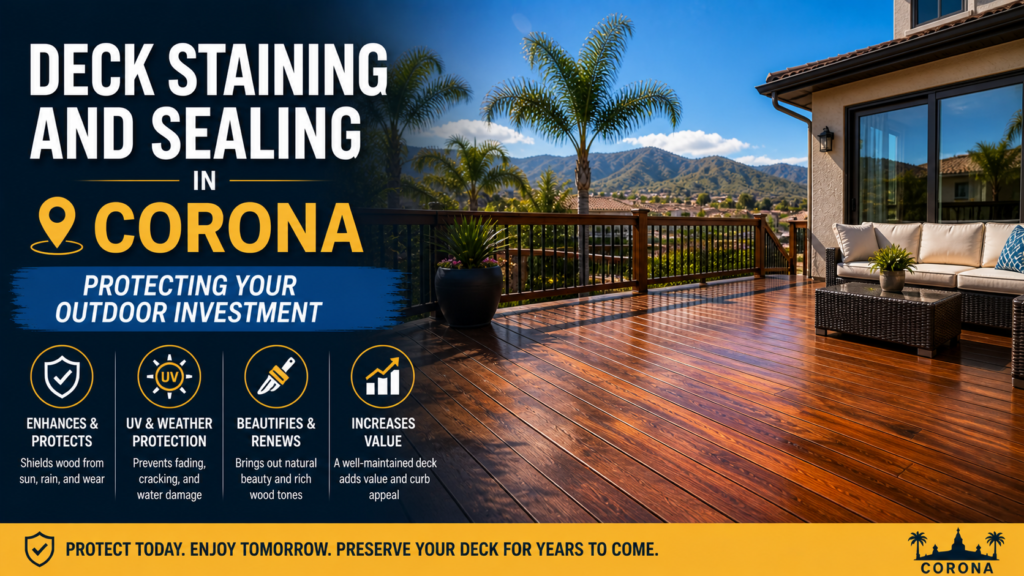
A deck is one of the most used outdoor spaces in a home, and in the sunny, warm climate of Corona, California, it faces some of the most demanding conditions that wood can endure. Intense UV exposure, seasonal temperature swings, and occasional heavy rain all take their toll on unprotected wood. Deck Staining And Sealing Corona is the essential maintenance practice that shields wood from these forces, preserving both its structural integrity and its appearance for years to come.
Why Deck Staining and Sealing Matters
Untreated or poorly maintained wood is vulnerable on multiple fronts. UV radiation breaks down lignin the natural binder that holds wood fibres together causing the surface to grey, crack, and splinter. Moisture absorption leads to swelling, warping, mould growth, and eventually wood rot. In Southern California’s climate, the combination of intense sun and seasonal rainfall creates a particularly demanding environment for outdoor wood structures.
Staining and sealing address these threats through complementary mechanisms. A stain penetrates the wood fibres and adds colour while providing UV-blocking pigments that prevent sun damage. A sealant creates a moisture-resistant barrier on or within the wood surface, preventing water from penetrating and causing rot or mould. Many modern products combine both functions in a single application, offering simultaneous UV protection and moisture resistance.
Understanding the Difference Between Stain and Sealant
The terms stain and sealant are often used interchangeably, but they serve distinct purposes that are worth understanding clearly.
A deck sealant is typically a clear or near-clear product designed primarily to repel moisture. It fills the pores of the wood and creates a water-resistant surface. Because it contains little or no pigment, a clear sealant offers minimal UV protection the sun’s rays pass through it and still break down the wood over time. This means that a sealant alone, while helpful for moisture resistance, is not a complete solution for outdoor wood in a sunny climate like Corona’s.
A deck stain penetrates the wood and adds colour through pigments. These pigments are what block UV radiation, acting as sunscreen for the wood. Semi-transparent stains allow the natural grain and texture of the wood to remain visible while providing UV protection. Solid stains cover the grain entirely, offering the highest level of UV shielding and a uniform colour appearance often the best option for older decks with surface imperfections.
The most effective approach combines the benefits of both: stain the wood first to establish colour and UV protection, then seal over it to lock in moisture resistance. Many premium products on the market today integrate both functions, making a single-step application possible.
Types of Stains and Their Characteristics
Choosing the right stain depends on the deck’s condition, the desired appearance, and how much sun the deck receives.
- Transparent Stains: Contain little or no pigment, allowing the full natural grain of the wood to show. These provide the least UV protection and are best suited to new wood in good condition, or for homeowners who prefer a completely natural look with the understanding that reapplication will be needed more frequently.
- Semi-Transparent Stains: Provide a hint of colour while allowing the wood grain to remain visible. They offer moderate UV protection and are one of the most popular choices for residential decks. Available in both oil-based and water-based formulations.
- Semi-Solid Stains: Provide more colour and more UV protection than semi-transparent options, while still allowing some of the wood’s texture and grain pattern to show through.
- Solid Stains: Completely cover the wood grain, functioning similarly to paint in appearance. Solid stains offer the highest UV protection of any stain category and are particularly well-suited for decks that have extensive weathering, discolouration, or surface imperfections that the homeowner wants to conceal.
The Staining and Sealing Process
The quality of a staining and sealing job is determined largely by the preparation that precedes product application. Applying stain or sealant to a dirty, wet, or poorly prepared surface dramatically reduces how well the product bonds to the wood and shortens its effective lifespan.
Preparation: Begin by clearing the deck of all furniture, planters, and accessories. Inspect the deck for damaged, loose, or rotting boards and address any structural issues before applying any protective product. Clean the surface thoroughly pressure washing combined with a dedicated deck cleaner removes dirt, mould, mildew, and old failing product residue. After washing, the wood must be allowed to dry completely, typically for at least 24 to 48 hours. Sanding follows, opening the wood grain and removing any mill glaze or grey surface fibres that would otherwise prevent product penetration.
Application: Stain and sealant should not be applied in direct, intense sunlight, as rapid drying can cause uneven absorption and lap marks. Working in the direction of the wood grain, apply the product using a brush, roller, or pad applicator, ensuring even coverage without puddling. Start with railings and trim, then work across the deck boards. Allow the first coat to dry fully before evaluating whether a second coat is needed.
Drying: While most products are dry to the touch within a few hours, the wood should not be walked on or have furniture returned to it for at least 48 hours to allow the product to cure properly.
How Often Should a Deck Be Stained and Sealed?
The frequency of reapplication depends on several factors: the product type used, the amount of foot traffic the deck receives, how much direct sun it is exposed to, and the regional climate. In Corona’s sunny climate, decks exposed to intense UV for most of the year typically need reapplication every one to three years. A simple water-bead test helps determine when the time has come: pour a small amount of water onto the deck surface. If it beads up, the existing protection is still working. If it soaks in quickly, the wood is absorbing moisture and it is time to reapply.
Conclusion
Deck staining and sealing in Corona is not simply a cosmetic project it is a necessary practice that preserves the wood, prevents costly structural repairs, and extends the life of one of the most valuable outdoor features of a home. Understanding the difference between staining and sealing, selecting the right product for the deck’s condition and the region’s climate, and approaching the process with proper preparation all combine to produce a result that looks beautiful and performs reliably for seasons to come.